Kashmir Solai Honey – Rare Raw and Natural Plectranthus Honey
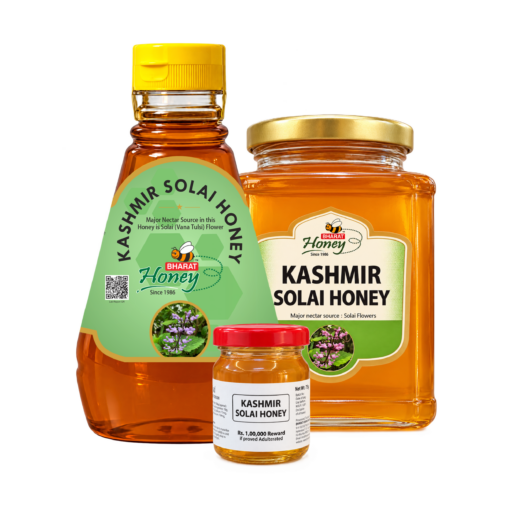
Bharat Kashmir Solai Honey is a distinctive pure, natural honey associated with the blossoms of the Solai plant growing in the Himalayan landscapes of Kashmir.
Also known as Plectranthus Honey or Sulai Honey, this variety is appreciated for its exceptionally light appearance, characteristic floral aroma and smooth taste.
One of its interesting natural characteristics is its tendency to form fine, pale crystals during colder weather, sometimes changing from a nearly transparent liquid into a creamy, whitish texture.
Other Names: Sulai Honey, Plectranthus Honey; sometimes called Vana Tulsi Honey
Origin: Kashmir Himalayan region
Fresh Appearance: Very light-coloured, sometimes nearly water-clear
Winter Characteristic: May form fine, pale crystals
Available Packs: 300g PET and 500g glass
What Is Solai Honey?
Solai Honey is a floral honey associated with nectar collected by honeybees from Solai shrubs growing in parts of the western Himalayas.
The plant has historically been identified as Plectranthus rugosus and is also classified botanically as Isodon rugosus. It belongs to the mint family, Lamiaceae.
Solai plants are known to grow on Himalayan slopes, where their flowering provides forage for honeybees.
When these blossoms form a predominant nectar source, the resulting honey can develop the distinctive characteristics associated with Plectranthus flowers.
Why Is Solai Honey Sometimes Called Vana Tulsi Honey?
The name Vana Tulsi is sometimes used for Solai Honey in traditional and commercial descriptions.
However, common plant names can vary between regions. Vana Tulsi may also be used for plants that are botanically different from Solai.
For greater clarity, Bharat Honey identifies this variety primarily as Kashmir Solai Honey and uses the botanical association with Plectranthus rugosus. The exact botanical identity of individual honey harvests should be supported by suitable sourcing or pollen-analysis evidence.
The Himalayan Landscape Behind Kashmir Solai Honey
The Kashmir Himalayas support a variety of seasonal flowering plants that provide nectar and pollen for honeybees.
Solai is among the flowering shrubs associated with the region’s hill slopes and seasonal honey flows.
Unlike many spring-flowering nectar sources, Solai flowering is associated particularly with late summer and autumn in suitable Himalayan locations.
Its seasonal availability gives Kashmir Solai Honey a distinct harvesting identity within the Bharat Honey collection.
Seasonal Flowering and Honey Production
Honey production depends on the flowering intensity, weather conditions and nectar availability around the honeybee colonies.
When Solai plants flower abundantly, honeybees may gather significant quantities of nectar from these blossoms.
Actual harvesting periods can vary according to altitude, rainfall, temperature and local flowering conditions. These factors can also influence the honey’s aroma, sweetness and appearance between harvests.
Why Is Kashmir Solai Honey So Light in Colour?
A defining characteristic of Bharat Kashmir Solai Honey is its very light, sometimes nearly transparent appearance when liquid.
Honey colour depends on the composition of its floral nectar and other naturally occurring constituents. It cannot be predicted simply from the colour of the flower petals.
Solai Honey’s light appearance is one of its attractive sensory features, but colour alone cannot prove botanical origin or honey authenticity.
Fine White Crystals During Winter
During colder periods, Kashmir Solai Honey may gradually crystallise, forming fine, pale crystals that create a creamy or whitish appearance.
This occurs because honey naturally contains glucose and fructose. The balance of sugars, moisture content and storage temperature influences crystal formation.
Crystallisation is a natural physical change and does not, by itself, mean that sugar has been added. It is also not sufficient evidence of purity on its own.
Taste and Aroma of Kashmir Solai Honey
Solai Honey is appreciated for its pleasant sweetness and distinctive floral aroma.
Its light colour may suggest a delicate honey, but colour and flavour intensity do not always correspond directly.
The honey can offer a characteristic floral taste that distinguishes it from Kashmir Acacia and other regional varieties.
Natural changes between harvests are possible because honeybees forage according to the flowering plants available around their colonies.
How Bharat Honey Sources Kashmir Solai Honey
Bharat Honey procures honey through direct relationships with beekeepers and honey-producing communities across different regions of India.
For Kashmir Solai Honey, the geographical origin, local flowering season and characteristics of available harvests are important considerations when sourcing.
We aim to select honey with the distinctive characteristics associated with the Solai floral source while maintaining appropriate handling and quality checks.
No middlemen. Direct from the source.
Preserving the Natural Character of Raw Solai Honey
Bharat Honey follows a limited-handling approach for its raw honey varieties.
Where necessary, honey is gently warmed to assist flow and strained through approximately 150–200 micron cloth to remove larger visible particles.
Our handling approach does not involve pasteurisation or ultrafiltration.
These practices are intended to avoid unnecessary processing and retain the honey’s characteristic flavour, aroma and natural composition.
Understanding the Monofloral Identity of Solai Honey
Solai Honey is commonly described as a monofloral variety because it is associated predominantly with nectar collected from Solai blossoms.
However, honeybees can visit other flowering plants within their foraging range. Suitable botanical and laboratory evidence is therefore important when assessing a monofloral claim.
Microscopic pollen analysis helps identify botanical pollen present in honey. The results should be interpreted together with relevant sensory and physicochemical characteristics.
A specific monofloral classification should be supported by the applicable requirements and evidence for the tested harvest.
Honey Authenticity and Laboratory Assessment
At Bharat Honey, we recognise that natural appearance and flavour are not enough to prove honey purity.
Appropriate laboratory methods can provide information about different aspects of honey quality and authenticity. These may include analytical screening for adulteration and separate methods for botanical-origin assessment.
Explore our available Bharat Honey Laboratory Reports. Any published result should be interpreted according to the honey variety, batch and sample identified in that report.
Kashmir Solai Honey and Kashmir Acacia Honey – What’s Different?
Both varieties are associated with the wider Kashmir region and can have relatively light appearances.
Their principal floral sources are different. Solai Honey is associated with Plectranthus blossoms, while Kashmir Acacia Honey is associated with blossoms of the black locust tree (Robinia pseudoacacia).
The two varieties can therefore differ in flowering season, aroma, flavour and crystallisation behaviour. They should not be treated as interchangeable simply because both come from Kashmir.
How to Enjoy Kashmir Solai Honey
The pleasant floral taste of Kashmir Solai Honey can complement a range of foods and beverages.
Direct Tasting: Try a small spoonful to appreciate its individual floral aroma.
Breakfast: Enjoy with bread, toast or chapati.
Tea: Use as a natural sweetener in your preferred beverage.
Curd and Porridge: Add a little honey for sweetness and flavour.
Crystallised Honey: Enjoy its naturally formed fine crystals as an alternative to liquid honey.
Honey naturally contains sugars and should be consumed in moderation as part of a balanced diet.
Storage and Natural Changes
Store Kashmir Solai Honey in a tightly closed container, away from moisture, excessive heat and direct sunlight.
Natural crystallisation may occur during storage, especially in cooler conditions. The formation of pale or white crystals does not necessarily indicate spoilage.
Follow the current product label for storage instructions and the declared best-before period.
Frequently Asked Questions About Kashmir Solai Honey
Are Solai Honey and Plectranthus Honey the same?
Yes. Solai Honey is commonly associated with the plant historically known as Plectranthus rugosus, also classified as Isodon rugosus. Plectranthus Honey is therefore another name used for this floral honey type.
Is Solai Honey the same as Tulsi Honey?
Not necessarily. Solai Honey is sometimes called Vana Tulsi Honey, but the term Vana Tulsi is used for different plants in different regions. The actual botanical source is more informative than a common name alone.
Why can Solai Honey be almost transparent when liquid?
Its very light colour is associated with the natural composition of the honey. Different floral nectar sources can produce honey with different shades, ranging from nearly water-clear to dark amber.
Does Kashmir Solai Honey remain liquid throughout winter?
Not always. Solai Honey may form fine, light-coloured crystals during winter. The rate and extent of crystallisation depend on its natural sugar composition and storage conditions.
Explore Kashmir Solai Honey at Our Experience Centre
Learn about the floral diversity of Kashmir honey and explore other distinctive varieties at the Bharat Honey Experience Centre in Hyderabad. You can discover different honey flavours through tasting, subject to the varieties currently available.
Customer Experiences
You can share your experience in the Reviews section of this product page. Explore Bharat Honey customer reviews from Amazon for feedback across our wider honey range.
Important Product Information
Bharat Kashmir Solai Honey is a natural food containing sugars. Its botanical origin does not establish specific medicinal or therapeutic properties.
Do not give honey to infants below 12 months of age.
Natural crystallisation can change the honey’s colour and texture without necessarily indicating adulteration.
Follow the product label for nutritional information, storage instructions and the best-before period.



Reviews
There are no reviews yet