Order for Rs. 1500 or more and get 10% Off. No Coupon Code Required.

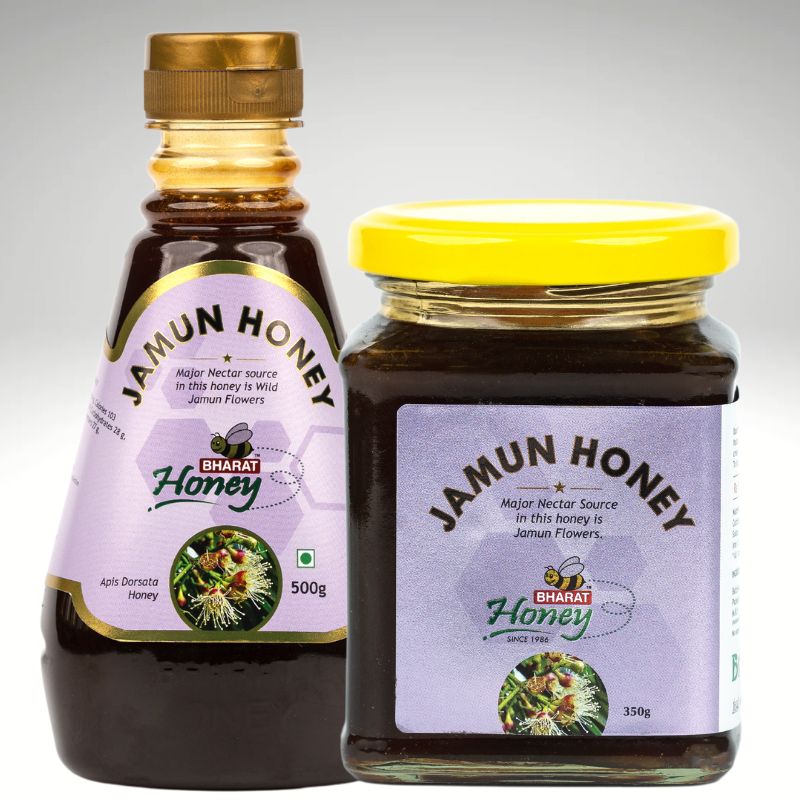

Jamun Honey / Bitter honey
Jamun Honey – Wild, Raw & Monofloral
Bharat Jamun Honey is a distinctive monofloral honey collected during the flowering season of the Jamun tree (Syzygium cumini).
It is not Jamun-flavoured honey and nothing is infused into it. Its characteristic colour, aroma and taste come naturally from the nectar collected by honeybees from Jamun flowers.
Our wild Jamun Honey is sourced directly from experienced honey hunters in northern India and is minimally processed to preserve its natural character.
Floral source: Jamun (Syzygium cumini)
Honeybee: Primarily wild Apis dorsata
Colour: Deep amber
Taste: Moderately sweet with a characteristic mildly bitter aftertaste
Texture: Naturally runny and turbid
Source: Selected regions of Uttar Pradesh, Bihar and Uttarakhand
Harvest season: Primarily during the Jamun flowering season
What Is Jamun Honey?
Jamun Honey is honey produced when bees forage predominantly on the flowers of the Jamun tree during its flowering season.
People sometimes assume that Jamun Honey means ordinary honey mixed with Jamun fruit, juice or flavour. That is not how genuine monofloral Jamun Honey is produced.
The bees themselves collect nectar from Jamun blossoms and convert it into honey inside the hive.
Honeybees may forage over a considerable area around their colony. When Jamun trees are flowering abundantly and provide a dominant nectar and pollen source, the resulting honey can develop the characteristic colour, aroma, taste and pollen profile associated with Jamun flowers.
Is Jamun Honey Really Monofloral?
The floral origin of honey cannot be established simply from its colour, taste or name.
Microscopic pollen analysis, together with the corresponding characteristics of the honey, is an important method used to establish floral origin.
Under FSSAI standards, honey may be described as monofloral honey when pollen from the concerned plant species constitutes at least 45% of the total pollen and the honey possesses the corresponding organoleptic, physicochemical and microscopic characteristics.
We therefore use pollen analysis to help verify the floral origin of our Jamun Honey.
Authenticity Backed by Pollen Analysis
Samples of Bharat Jamun Honey are sent for microscopic pollen analysis.
During this examination, pollen grains present naturally in the honey are identified and counted under a microscope. The percentage of Syzygium cumini pollen provides objective evidence supporting its Jamun floral origin.
Our pollen-analysis reports are available for customers to view on our Laboratory Reports page.
Where a batch-specific percentage is available, we recommend checking the corresponding report because pollen composition can naturally vary from one harvest to another.
What Does Jamun Honey Taste Like?
Jamun Honey has one of the most distinctive taste profiles among the varieties of honey we source.
It is generally less overtly sweet than many light-coloured honeys and has a characteristic, slightly bitter aftertaste.
Its aroma is also quite different from varieties such as Litchi, Acacia or Multiflora Honey.
Nothing is added to produce this flavour. The differences arise naturally from the floral source.
This variation is one of the fascinating characteristics of genuine monofloral honey: honey produced from different flowers can vary considerably in colour, aroma, taste and consistency.
Colour of Jamun Honey
Jamun Honey is normally deep amber to dark amber.
The precise colour can vary between harvests according to factors including floral conditions, location and storage.
Honey can also naturally become darker over time, particularly when stored for long periods or exposed to higher temperatures.
Natural variations in colour should therefore not be considered a defect.
Why Is Our Jamun Honey Naturally Turbid?
Our Jamun Honey may look different from highly filtered supermarket honey.
Wild honey is extracted from honeycomb and then gently strained to remove unwanted visible material while retaining much of its natural character.
As a result, naturally occurring pollen and very fine suspended particles may remain in the honey, giving it a comparatively turbid appearance.
Sedimentation or separation of some natural particles can also occur during storage.
Visible pollen or turbidity alone should not be considered a test of honey purity. Proper laboratory testing is required when evaluating adulteration and authenticity.
Why Can Jamun Honey Be Runny?
The consistency of natural honey varies considerably.
Floral source, moisture level, maturity of the honey, harvesting conditions and storage temperature can all influence whether honey appears thick or runny.
For this reason, thickness should never be used as a home test for honey purity.
Our Jamun Honey frequently has a comparatively fluid consistency, and natural variations between batches are expected.
How Bharat Jamun Honey Is Sourced
We have decades of experience working with natural honey and have developed direct relationships with honey collectors and beekeepers in different parts of India.
For wild Jamun Honey, we procure from regions where wild Jamun trees are abudant.
Wild Apis dorsata, commonly called the giant or rock honeybee, builds large combs.
During the Jamun flowering season, these colonies can collect substantial amounts of nectar and pollen from Jamun blossoms.
We procure the honey directly from experienced honey hunters rather than depending on intermediaries.
After procurement, the honey is carefully handled, strained and prepared for packing with the objective of retaining its natural characteristics.
Wild Jamun Honey vs Apiary Honey
Both wild bees (Apis Dorsata) and managed honeybees (Apis Mellifera) can produce natural honey.
Our preference for selected Jamun harvests from wild Apis dorsata colonies comes from the distinctive honey we have encountered through years of direct procurement.
This should not be interpreted to mean that genuine apiary honey is inferior. They are simply different methods of honey production.
Wild honey reflects natural bee colonies foraging in their surrounding habitat, whereas apiary honey is produced by managed bee colonies placed by beekeepers near flowering crops or forests.
How We Check the Authenticity of Jamun Honey
There are two separate questions when authenticating a monofloral honey:
1. Is the honey free from detectable adulteration?
2. Does its floral profile support its description as Jamun Honey?
These questions require different forms of testing.
1. Advanced Laboratory Testing for Adulteration
Selected Bharat Honey batches are tested using advanced analytical techniques at laboratories including Intertek Germany.
As Bruker (Intertek) does not have the data for Apis dorsata of Indian honey, The preferred Methods we use is LC-HRMS which can detect any possible adulterants in honey.
Customers can view available test reports on our website.
2. Microscopic Pollen Analysis
Laboratory testing for adulteration and pollen analysis serve different purposes.
Pollen analysis helps establish the botanical origin of honey.
Under a microscope, pollen grains can be classified according to their botanical characteristics. The relative proportion of Jamun pollen (Syzygium cumini) provides evidence about the floral source of the honey.
This is why we do not rely only on taste, colour or aroma when describing Jamun Honey as monofloral.
Organoleptic Characteristics of Jamun Honey
Organoleptic evaluation refers to characteristics that can be experienced through the senses, particularly:
- colour
- aroma
- taste
- aftertaste
- texture
Experienced honey handlers often recognise characteristic differences between floral varieties.
Jamun Honey is particularly identifiable for its deep amber appearance and characteristic aroma and mildly bitter finish.
However, sensory characteristics should be considered alongside laboratory and pollen analysis, rather than being treated as proof of purity on their own.
About Jamun Flowers
The Jamun tree (Syzygium cumini), also known as Java plum or Indian blackberry, is native to the Indian subcontinent and other parts of South Asia.
It produces clusters of small flowers that provide nectar and pollen for visiting insects, including honeybees.
The timing and intensity of flowering depend on geography, weather and local environmental conditions.
In suitable areas of northern India, the Jamun flowering period creates an important seasonal forage opportunity for bees.
This relatively short harvesting window is one reason Jamun Honey has a distinctive seasonal identity.
Why Every Batch Can Be Slightly Different
Natural honey is an agricultural product produced by bees, not a standardized factory syrup.
Differences in rainfall, temperature, surrounding vegetation, flowering intensity, bee colonies and harvesting conditions can influence each crop.
Therefore, one batch of Jamun Honey may be somewhat darker, lighter, thicker, thinner, sweeter or more bitter than another.
We consider these natural variations part of the character of genuine honey rather than something that needs to be artificially standardized.
Does Jamun Honey Crystallize?
Depending on its sugar profile, temperature and storage conditions, honey may crystallize over time.
Crystallization is therefore a natural physical process and does not, by itself, mean that sugar has been added.
Different floral varieties crystallize at different rates. Compare to other monoforal honey jamun honey is less likly to crystallise.
How to Store Jamun Honey
Keep the container tightly closed and store it in a cool, dry place away from excessive heat and moisture.
Honey is hygroscopic, meaning it can absorb moisture from the surrounding atmosphere when left exposed. Excess moisture can affect its stability and may increase the risk of fermentation.
Always use a clean, dry spoon.
Do not refrigerate simply to preserve the honey. Lower temperatures can encourage crystallization.
If the honey develops an unusual alcoholic odour, excessive foaming or other signs of fermentation, contact us before consuming it.
How to Use Jamun Honey
Jamun Honey can be enjoyed just as you would enjoy other natural honey.
Use it:
- directly by the spoon
- as a natural sweetener in suitable foods and drinks
- over toast or breakfast foods
- with yoghurt or cereals
- in dressings and recipes
- to compare the flavour with other monofloral honeys
Avoid adding honey to extremely hot food or beverages if your objective is to retain its natural characteristics.
Honey remains a source of naturally occurring sugars and should be consumed appropriately as part of the overall diet.
Why Choose Bharat Jamun Honey?
Our objective is not simply to sell another sweet-tasting honey.
We want consumers to experience the natural differences between honeys produced from different floral sources.
For Jamun Honey, our focus is on:
Direct sourcing from the region of harvest
Wild honey collection from experienced honey hunters
Minimal processing
Retention of natural characteristics
Microscopic pollen analysis for floral-origin verification
Advanced laboratory testing for adulteration screening
Transparency through published laboratory reports
That combination allows customers to judge our honey based on traceability, testing and the product itself rather than relying on unreliable household purity tests.
Frequently Asked Questions About Jamun Honey
What is Jamun Honey?
Jamun Honey is honey produced when bees collect nectar predominantly from the flowers of the Jamun tree (Syzygium cumini) during its flowering season.
Is Jamun Honey flavoured with Jamun?
No. Genuine Jamun Honey does not require Jamun fruit, juice or flavour to be added. Its characteristic flavour originates naturally from the floral source.
Is Jamun Honey monofloral?
A honey can be described as monofloral when its pollen profile and corresponding characteristics meet the applicable requirements. Under FSSAI standards, the concerned plant pollen should constitute at least 45% of total pollen for monofloral honey.
Bharat Honey uses microscopic pollen analysis to verify the botanical profile of tested Jamun Honey batches.
Where does Bharat Jamun Honey come from?
We procure selected wild Jamun Honey directly from honey-hunting networks in parts of northern India, including Uttar Pradesh, Bihar and Uttarakhand, according to seasonal availability.
What does Jamun Honey taste like?
It typically has a deep flavour, moderate sweetness and a characteristic slightly bitter aftertaste. Natural variations occur between harvests.
Why is Jamun Honey runny?
Honey consistency depends on several factors including floral source, natural sugar composition, moisture, maturity and temperature. A runny consistency does not indicate that water has been added.
Is Jamun Honey supposed to be dark?
Jamun Honey is generally deep amber. Colour varies naturally between harvests and may darken during storage.
Does Jamun Honey contain Jamun fruit?
No. The honey is derived from nectar collected from Jamun flowers, not from Jamun fruit.
Does Jamun Honey have the same properties as Jamun fruit?
Jamun Honey and Jamun fruit are different foods with different compositions. We therefore do not claim that honey produced from Jamun flowers possesses the same nutritional or physiological properties as Jamun fruit or Jamun seeds.
How do you verify that it is Jamun Honey?
Microscopic pollen analysis is used to assess botanical origin. The results are considered together with the honey’s corresponding characteristics.
How do you check its purity?
We use analytical laboratory testing rather than relying on household purity tests. Available laboratory reports can be viewed on the Bharat Honey website.
Can people with diabetes consume Jamun Honey?
Honey contains naturally occurring sugars. People with diabetes or anyone who has been advised to control carbohydrate or sugar intake should follow the advice of their qualified healthcare professional rather than assuming Jamun Honey has the same properties as Jamun fruit.
Can natural Jamun Honey vary from bottle to bottle?
Yes. Honey is a seasonal agricultural product. Colour, aroma, taste and consistency can vary according to location, weather, flowering conditions and harvest.
Experience Different Floral Honeys
Jamun is only one of India’s fascinating floral honeys.
Compare its deep amber colour and characteristic finish with lighter and more aromatic varieties such as Litchi Honey or with other distinctive floral honeys such as Ajwain, Sidr and Acacia.
For customers who want to compare several varieties side by side, Bharat Honey’s assorted honey sampler provides an opportunity to experience the natural diversity of Indian honey.
Bharat Honey — direct from the source, carefully handled and backed by testing.
Some people confuse Jamun honey with jamun-infused or flavored honey, but that’s not the case. This is 100% natural honey, harvested by honey hunters, with the primary nectar source being Jamun flowers (Syzygium Cumini). Honeybees travel around 2 km to collect this nectar. According to FSSAI, if 50% of the nectar comes from one type of flower, the honey can be attributed to that source—hence the name Jamun honey. This type of honey is mono-floral, or single-flower honey, which can be confirmed through microscopic pollen analysis.
Characteristic features of Jamun honey
Bharat’s Jamun Honey is nothing like the regular honey you’ll find on store shelves. It has a naturally turbid appearance due to its high pollen content, which comes from our squeezed extraction method. Since pollen is lighter than honey, it gradually rises to the top, forming a distinct layer over time—clear evidence of its authenticity and purity. If stored for long, you’ll notice this layer getting thicker.
Taste of wild Jamun honey
The taste and aroma are truly unique, less sweet and slightly bitter, with a characteristic fragrance that comes from the pollen present in it. This honey is as natural as it gets!
The color
The color of Bharat’s Jamun Honey is a deep amber that becomes even darker with age. This natural darkening occurs because the carbohydrates in the honey react with proteins found in pollen, especially in warm conditions.
consistency
Jamun Honey is thinner and more runny compared to other types of honey. This natural consistency is due to the humid environment and proximity to water bodies in the collection areas.
If honey is exposed to a humid atmosphere, it may develop a slightly sour taste due to mild fermentation. That’s why we always recommend storing honey in a cool, dry place to maintain its quality and rich flavor.
How jamun honey is procured ? Why Wild & why not Apiary ?
Apis Dorsata, also known as the rock bee, thrives on Jamun flowers, which is why Bharat Honey prefers wild honey over apiary Jamun honey. With nearly four decades of experience in procuring wild honey, Bharat Honey has built a strong network of honey hunters in Uttar Pradesh, Bihar, and Uttarakhand.
We collect honey directly from these experienced honey hunters, clean the raw honeycombs of larvae and excess pollen, and carefully squeeze them to extract pure honey. For those seeking an even more authentic experience, we also offer comb honey—unprocessed honeycombs, left untouched for you to enjoy in their natural form.
| Weight | 1.2 kg |
|---|---|
| Dimensions | N/A |
| weight | 200 g, 300 g PET, 350 g (Glass jar), 500 g, 500 g (Glass jar) |
19 reviews for Jamun Honey
94%
5%
0%
0%
0%
Only logged in customers who have purchased this product may leave a review.


TAUSHIF JAMAL (Verified Customer.) –
So, far one of the most authentic and trustworthy “Honey” discovered by me after consuming mostly corn syrup in the name of honey and what not all this years by major brands out there😅…..this brand not only maintain the exquisite taste of original wild bee honey but the aroma in general and most importantly it don’t gets crystallize when you store in room temperature. I hope “Bharat Honey” keeps up the good work and maintain their authenticity and quality for long term in future as well👍🏼
ATIQUE AHMAD (Verified Customer.) –
Satyanarayana V. (Verified Customer.) –
Honey is not very sweet, and very thin. It has a mild taste of jamun as the nector is said to be dervied from jamun flowers. Goes well with my morning green tea with fresh lemon.
SADDAM KHAN (Verified Customer.) –
Looks really nice and delicious in taste.
ALOK MITTAL (Verified Customer.) –
Shakeeb Ansari (Verified Customer.) –
Anonymous (Verified Customer.) –
Sumit Chawla (Verified Customer.) –
Very Good
AYESHA RAEES (Verified Customer.) –
Taste is so good
Konda (Verified Customer.) –
Good Quality 👍 very nice
Suresh Nambiar (Verified Customer.) –
Praful Bhanushali (Verified Customer.) –
ALEXANDER P. (Verified Customer.) –
Bharat Bhushan –
Review for Jamun Honey
★ ★ ★ ★ ★
Bharat Bhushan –
I have taken lots of honey in My life.. But this Bharat Jamun Honey is Most fabulous Honey that I have tasted ever..
1 million star from my side.
Arnab –
A good quality Jamun honey, I highly recommend it. A nice natural product.
BHARAT HONEY OFFICE –
Thanks for valuable feedback.Your appreciation gives us strength to grow.
Anchal –
A real Jamun honey its aroma and taste gives me the feeling of pure Jamun experience.
BHARAT HONEY OFFICE –
Thanks for valuable feedback.Your appreciation gives us strength to grow.
Pritam –
I got this Jamun honey and It tastes like a real raw jamun honey for sure. What a product!
Amlan –
If you want pure and fresh Raw honey, so then you must visit this place. Jamun honey has a unique taste.