Order for Rs. 1500 or more and get 10% Off. No Coupon Code Required.



Can you identify pure honey using a glass of water? Does real honey crystallize? Can laboratories detect added sugar syrups?
These are common questions among people buying honey in India. Unfortunately, many popular answers are misleading.
Imagine placing two jars on a table. One contains genuine honey collected by bees from flowers. The other contains honey mixed with sugar syrup. Both may have a similar golden colour, sweetness and thickness.
Can you identify which jar is pure just by looking at it?
The answer is no.
As honey adulteration techniques become increasingly sophisticated, identifying genuine honey is more challenging than ever.
Internet searches and popular beliefs often promote home testing methods as simple ways to verify honey purity.
However, these methods can be misleading because they primarily assess physical properties, such as density, thickness, viscosity, or moisture content, rather than the honey’s actual composition.
As a result, they can produce both false positives and false negatives. Adulterated honey may pass these tests if it has a consistency similar to genuine honey, creating a false impression of purity. Conversely, naturally thin honey may fail a test and be wrongly classified as adulterated.
Honey Authenticity Guide:
1) What Is Honey Adulteration?
Honey adulteration means fraudulently changing or misrepresenting honey, commonly to reduce production costs, increase volume or make misleading claims about its identity.
It can occur in two ways.
A. Direct adulteration
This happens when sugar syrup or another undeclared substance is added to harvested honey.
Examples include:
- Liquid Glucose
- High Fructose corn Syrup
- Rice-derived syrup.
- Invert sugar syrup.
- Cane and beet sugar syrups
B. Indirect adulteration involving bee feeding
If honey bees are fed sugar syrup and they store it in the honeycomb, selling that syrup as natural floral honey is considered adulteration. However, feeding bees sugar syrup for colony maintenance when honey is not being produced is a normal beekeeping practice.
2) Why Has Honey Adulteration Increased?
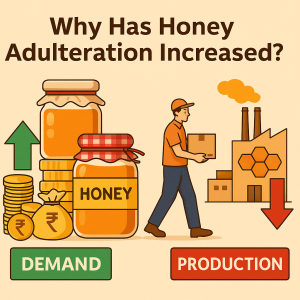
The demand for honey has skyrocketed—thanks to its popularity as a natural sweetener and health booster. However, natural honey production is limited, and meeting market demands through ethical beekeeping alone is not always profitable.
This gap has led to widespread honey adulteration, where producers mix cheap additives like rice syrup, HFCS (High Fructose Corn Syrup), invert sugar, and liquid glucose to increase volume and reduce costs.
Unfortunately, these adulterants not only degrade the nutritional value of honey but also pose health risks.
3) Common Adulterants Found in Honey
Understanding the nature of these additives is the first step in recognizing fake honey.
1. Rice Syrup
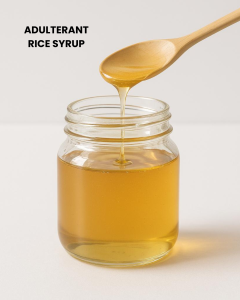
Derived from rice starch using enzymes, rice syrup mimics the consistency and sweetness of natural honey. It’s one of the most difficult adulterants to detect and can only be reliably identified by NMR and LC-HRMS testing.
2. High Fructose Corn Syrup (HFCS)
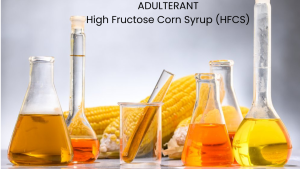
HFCS is processed from corn and shares a similar viscosity and sweetness profile with honey. Many large commercial honey brands use this adulterant to cut costs. It’s invisible to traditional tests and requires NMR or isotope analysis for detection.
3. Invert Sugar
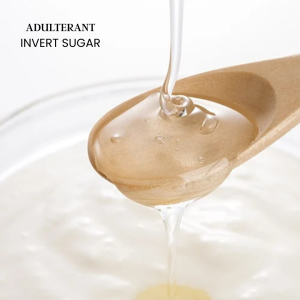
Made by hydrolyzing sucrose into glucose and fructose, invert sugar closely resembles honey in texture and moisture. While it passes many crude tests, it’s chemically distinct and detectable through modern lab analysis.
4. Liquid Glucose
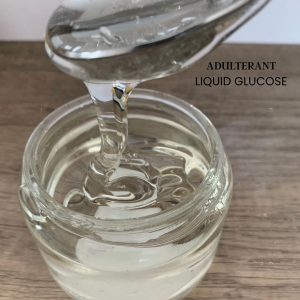
Clearer and sweeter than honey, this syrup often misleads consumers who judge honey based on appearance. But again, its presence is unmistakable under modern equipment.
5. Molasses
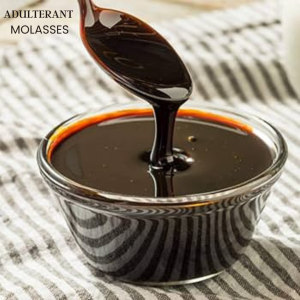
Once a common adulterant, molasses is no longer widely used as it is easily detectable due to its dark color, turbidity, and solubility in water.
Identifying Common Honey Adulterants — Key Laboratory Tests
|
Adulterant |
Key test |
What the test may reveal |
|---|---|---|
|
1. Molasses (cane) |
Sucrose value |
Abnormally high sucrose may indicate addition. C4 isotope testing can provide stronger evidence. |
|
2. Liquid glucose |
Fructose/Glucose (F/G) ratio |
Excess glucose may reduce the F/G ratio. Sugar profiling can provide additional evidence. |
|
3. High-fructose corn syrup (HFCS) |
Carbon isotope (C4) testing |
Detects a difference in carbon isotope composition associated with corn-derived sugar. |
|
4. Invert sugar syrup |
HMF or carbon isotope testing |
High HMF may raise suspicion of acid-inverted syrup. C4 testing can detect cane-derived invert syrup. |
|
5. Rice syrup |
SMR (LC-MS/MS), NMR or LC-HRMS |
Detects rice-syrup markers or abnormal chemical fingerprints that simpler tests may miss. |
Why Home Tests for Honey Purity Are Misleading
Social media and YouTube are full of so-called “DIY honey purity tests”, but most are unreliable and scientifically invalid. Let’s break down the popular ones:
🔹 Water Test (Solubility Test)
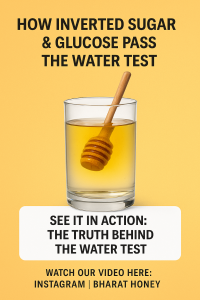
See It In Action: The Truth Behind the Water Test
Many believe that if honey sinks in water, it must be pure. But this is scientifically misleading. As demonstrated in our short explainer video, thick adulterants like inverted sugar and liquid glucose can also pass this test and appear “pure” to the naked eye.
👉 Watch our video here: How Inverted Sugar & Glucose Pass the Water Test
(Instagram | Bharat Honey)
This reel visually proves how outdated home tests often fail—and why lab testing is the only reliable way to detect honey adulteration.
This test checks if honey sinks in a glass of water. But thick adulterants like rice syrup or HFCS can sink too. Worse, unripe natural honey may dissolve quickly, giving a false negative.
🔹 Flame or Matchstick Test
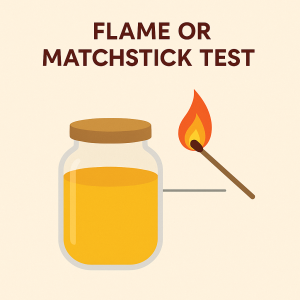
Based on moisture levels—if honey burns, it’s considered pure. But low-moisture adulterants can also pass. Some floral honeys with higher natural moisture may fail. Not reliable.
🔹 Thumb Test
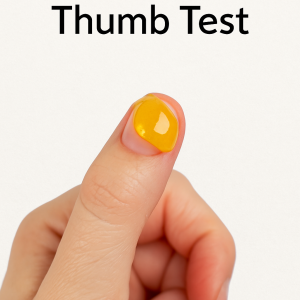
Supposedly, pure honey doesn’t spread on the thumb. Again, thick sugar syrups behave the same way.
🔹 Blot Paper Test
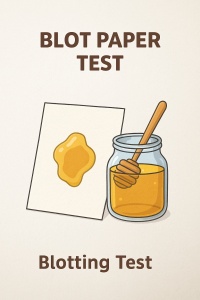
Pure honey shouldn’t spread. But syrup-thick adulterants also don’t spread, making this another test that rewards fake honey.
🔹 Currency Note Test
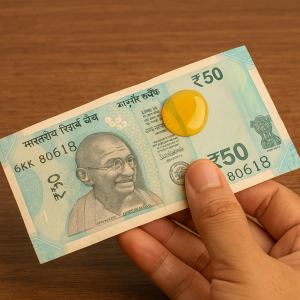
Lighting honey-soaked currency to prove purity is not only dangerous—it’s baseless. Any thick syrup can pass.
🔹 Honeycomb Pattern in Water
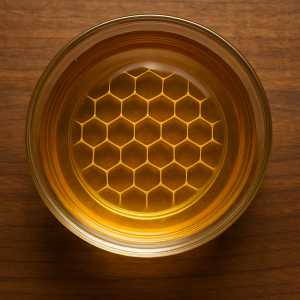
Shaking honey in water to see a pattern is a visual trick. Viscous adulterants can form similar designs. It’s not proof of authenticity.
🔹 Ant and Dog Tests


Myths like “ants don’t eat pure honey” or “dogs won’t lick it” are completely unscientific. Sugar = attraction, regardless of source.
How is Real Honey Tested? — Modern & Scientific Methods
To truly detect adulteration, honey needs to be tested using scientific techniques that examine its chemical composition. These are the standard methods used by quality brands and labs.
✅ FSSAI Parameters for Honey Purity (India)
The Food Safety and Standards Authority of India (FSSAI) has outlined strict guidelines to ensure honey purity. Here are the key parameters:
| Test Parameter | FSSAI Limit | Why It Matters |
|---|---|---|
| Moisture Content | < 20% | High moisture = fermentation risk. |
| Fructose + Glucose | > 60% (blossom) / > 45% (honeydew) | Indicates natural sugar content. |
| Sucrose | < 5% | High levels = added sugar. |
| Hydroxymethylfurfural (HMF) | < 40 mg/kg (tropical) / 80 mg/kg (others) | Indicates overheating or aging. |
| Diastase Activity | > 8 (Gothe scale) | Shows honey is raw and enzymatically active. |
| Electrical Conductivity | < 0.8 mS/cm (blossom) / > 0.8 mS/cm (honeydew) | Helps identify floral source. |
| Total Reducing Sugars | > 65% (blossom) / > 45% (honeydew) | High levels confirm natural sweetness. |
| Ash Content | < 0.6% | Excess = contamination or impurities. |
| Proline Content | > 180 mg/kg | Confirms natural botanical origin. |
| C4 Sugar Detection | Should not be present | Detects corn syrup and cane sugar adulteration. |
| Rice Syrup Marker | Absent | Ensures rice syrup hasn’t been added. |
| Water-Insoluble Matter | < 0.1% | Reflects cleanliness and filtration quality. |
| Pollen Count | Present | Ensures real nectar source and not synthetic honey. |
International Testing Methods for Advanced Adulteration
When it comes to premium honey or export-quality testing, these are the gold standard methods used globally.
1. 🧪 Carbon Isotope Ratio Testing (EA-IRMS / LC-IRMS)
-
What it does: Detects C4 sugars (like corn syrup) and C3 sugars (like rice syrup) using carbon isotope differences.
-
Accuracy: EA-IRMS is very effective for C4 adulterants. LC-IRMS is excellent for C3 detection.
-
Limitation: Doesn’t detect synthetic additives or unknown compounds.
2. 🔬 Nuclear Magnetic Resonance (NMR)
-
What it does: Offers a complete chemical profile of honey.
-
Key strengths: Detects known and unknown adulterants. Verifies botanical and geographical origin.
-
Used by: INTERTEK Germany, a leader in global honey purity analysis.
-
Limitation: Database-dependent and expensive.
3. ⚗️ Liquid Chromatography–High Resolution Mass Spectrometry (LC-HRMS)
-
What it does: Separates and analyzes honey components with high accuracy.
-
Strengths: Detects trace amounts of complex adulterants, even tailor-made ones.
-
Used for: Regulatory testing, premium certifications, and brand authenticity.
🔍 Comparison Table
| Detection of | EA-IRMS | LC-HRMS | NMR |
|---|---|---|---|
| C4 Sugars | ✅ Very Effective | ✅ Very Effective | ⚠️ Somewhat Effective |
| C3 Sugars (e.g. rice) | ⚠️ Limited | ✅ Highly Effective | ⚠️ Somewhat Effective |
| Tailor-Made Syrups | ❌ Not Effective | ✅ Very Effective | ❌ Not Effective |
| Synthetic Processing | ❌ | ⚠️ Sometimes | ✅ Very Effective |
| Botanical/Geographical | ❌ | ❌ | ✅ Highly Effective |
So, How Can You Really Know If Honey is Pure?
It’s simple:
-
Ignore home tests. They’re myths, not science.
-
Look for lab-tested honey. NMR-tested honey is the gold standard.
-
Choose brands that publish full lab reports and test internationally.
-
Beware of heavy discounts and “shiny” supermarket honey.
CONCLUSION
Adulterated honey is not just a scam—it’s a threat to health, farmers, and trust. If identifying fake honey were as easy as dropping it in water, adulteration wouldn’t be a billion-rupee business.
To stay safe and make informed choices, trust brands that use modern lab testing like NMR, LC-HRMS, and isotope ratio analysis. Understand FSSAI parameters and demand proof of purity.
Because when it comes to honey, purity isn’t just a label—it’s a responsibility.
____________________________________________________________________________________________________________________________________________________________________________
Thank you so much for giving this information. It will surely help people and also will get depth knowledge and awarness on honey.
What is the chance that honey that has crystallized is pure? I bought a brand that crystallizes that is being sued for adding things to their honey. I have a good science background. Thank you for your time!
If honey gets crystallized, one should know that it is a natural phenomenon.
Many brands modify honey(to stop Crystallization) to the extent that, it suppresses nutritional and medicinal value.
Please watch an informative video on the Crystallization of honey. https://www.youtube.com/watch?v=5GNaiJpjvE0
I bought honey from one of the local catcher. I tried all these old testing methods. Mostly passed too. Kept in an stainless steel container. After some months later, it become very hard. Kind of cake. If I keep in sunlight, started melting. Smell & taste everything looks real honey. Totally confused. Did I fail in procuring fake adulterated honey. Please suggest.
Don’t worry Crystallization of honey is a natural phenomenon. If honey gets crystallized, there are more chance that it’s pure.